PROGRAMME : Bird Watching Tour. (standard)
DURATION : 9 Nights / 10 Days.
PERIOD :01-Nov-2004 To 31-Oct-2005
TOUR ITINERARY
Day 1 - Arrival & transfer to Waikkala (HB)
Arrival & transfer to Ranweli Holiday Village in Waikkala.
This hotel is located in a nature reserve and situated on a sandy beach with a swimming pool.
WAIKKALA is located in the Puttalam District, which falls into the dry zone category. Waikkala is in the midst of marine, coastal, estuarine, mangroves, marshland and man made habitat systems. All of these have contributed to the avifaunal diversity visible in the immediate surrounding. Much of the avifauna is characteristically wetland.
More than 60 species of birds can be observed here.
Eg: Common sandpiper, little ringed plover, Purple coot, Painted stork, Stork billed king fisher, little green heron etc.
Evening at leisure or optional canoe ride.
Dinner and Overnight at Ranweli Holiday Resort or similar.
Day 2 - Waikkala – Muthurajawela – Waikkala (FB)
Bird watching trail followed by Breakfast at the hotel. Plenty of birding in the surroundings.
After lunch leaving to Muthurajawela or Anawilundawa for bird watching.
 MUTHURAJAWELA
 is located south of Negombo in the Colombo district. A vast area of marshland and mangrove vegetation with an extent of 3100 hectares of which 1000 hectares is declared as sanctuary. This important wetland habitat is home to 85 resident birds.
Night back at Ranweli Holiday Village or similar.
Day 3 - Waikkala – Dumbula – Kandalama - Dambulla (FB)
After breakfast leave Ranweli – Waikkala & proceed to Dumbulla. Visit the Dumbula cave temple.
DAMBULLA, an ancient city, is known for its beautiful Cave temples and a huge Buddha statue. The history of the 5 caves containing over 150 images of Buddha goes back to 1st century BC when king Valagambahu took refuge here. This place is worth visiting not only for the cave temple, but also for the beautiful view over the countryside you can get from the hill.
Evening Bird watching at Kandalama – Lake (Bird Island)
Night at Culture Club or similar.
Day 4 - Dambulla – Sigiriya - Dambulla (FB)
After breakfast a visit to the Sigiriya Rock Fortress.
SIGIRIYA sanctuary with extent of 51,099 ha. is in the Polonnaruwa District. This sanctuary holds a great significance, as it has within its borders the world famous Sigiriya – a world heritage site, among other archeological sites. Sigiriya also has a large population of migratory elephants, apart from the presence of many other large mammals. Another important factor is the presence of Loris is this sanctuary. There are about 150 species of birds found in this area.
Eg:- Oriental Sharma, Pompador Green Pigeon, Shahin falcon, crested hawk Eagle. Rufus bellied hawk Eagle and Greater.
Evening bird watching around the pramisies & back to the Hotel
Night at Culture Club or similar.
Day 5 - Dambulla – Kandy – Udawattakele - Kandy (FB)
After breakfast leaving Dumbulla & you will proceed to Kandy via Matale.
KANDY, Sri Lanka’s hill capital stronghold of the Sinhala kings, repository of culture, religious center is Sri Lanka’s most beautiful town. Focal point of this city is the Dalada Maligawa, were the sacred Tooth Relic of the Buddha is enshrined. Highlight of the year is the Kandy Esala Perahera, when a replica of the relic casket is paraded in the streets, accompanied by exotically costumed dancers, drummers and anything from eighty to a hundred gaily-caparisoned elephants, for ten littering festival nights. Once in Kandy you can’t miss the lovely artificial lake built by the last Sinhala king, Sri Wickrama Rajasinghe, in 1806.
After lunch at the hotel, leave for Udwattakale Nature Reserve.
UDAWATTAKELE is a Buddhist sanctuary and there is a temple in the vicinity. Vegetation comprises fairly dense forest, mostly plantation and secondary formations. About 80 species of bird have been recorded from the area
The history of the gardens goes as far back as1371. The gardens is a horse-shoe-shaped peninsula round which flows the chief river of Sri Lanka, the Mahaweli. The total area is 147 acres containing more than 4000 plant species.
Night at Suisse Hotel or similar.
Day 6 - Kandy - Nuwara Eliya – Horton Plains – Nuwara Eliya (FB)
After breakfast leaving Kandy to Nuwara Eliya.
NUWARA ELIYA has a cool sparkling climate with the temperature changing around 13degC this is an exquisite and healthy city famous for its wide range in flowers. With buildings of English architecture everywhere in the city, it is affectionately called little England. The Victoria Park in the center of Nuwara Eliya, the highest town in Sri Lanka. Yellow-eared Bulbul, Blackbird, in winter Pied Thrush and Kashmir Flycatcher are very common.
From Nuwara Eliya proceed to Horton Plains. Lunch on the way.
HORTON PLAINS NATIONAL PARK is undoubtedly one of the world’s best nature reserves. It is characterised by a beautiful landscape of rolling hills, covered in upper montane forest and wet patana grassland. In general, the forests are seen on the hilltops or upper slopes, and the grasslands in the valleys and lower slopes, eventually giving way to wetland habitats. Spanning approximately 10,000 hectares the park is also home to a wide variety of flora (57 species, 29 endemic to Sri Lanka) and 24 species of mammals such as elk, deer, giant squirrel, wild boar, wild hare, porcupine and leopard. For bird enthusiasts, there are 87 species (14 of which are endemic), including many migratory birds. The Plains also feature many interesting attractions such as ‘Baker’s Falls’, ‘Chimmini Pool’ and the famous ‘World’s End’ (a 3700 ft sheer drop that offers fabulous views of the tea estates below and all the way out to the distant southern coastline).
Finishing the visit back to Nuwara Eliya for the night at Galway Forest Lodge or similar.
Day 7 - Nuwara Eliya - Yala (FB)
Leaving Nuwara Eliya to Yala.
YALA NATIONAL PARK lies 24km northeast of Tissamaharama and 290km from Colombo on the southeast coast of Sri Lanka, spanning a vast 97,878 hectares over the Southern and Uva Provinces. The vegetation in the park comprises predominantly of semi-arid thorny scrub, interspersed with pockets of fairly dense secondary forest. Small patches of mangrove vegetation also occur along the coastal lagoons. The park is renowned for the variety of its wildlife (most notably its many elephants) and its fine coastline (associated with beautiful coral reefs). It also boasts a large number of important cultural ruins, bearing testimony to earlier civilizations and indicating that much of the area used to be populated and well developed.
SOME OF THE BIRDS IN YALA
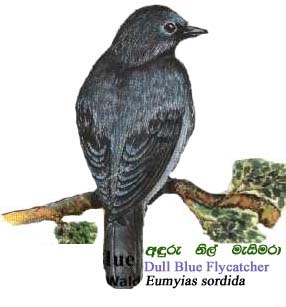
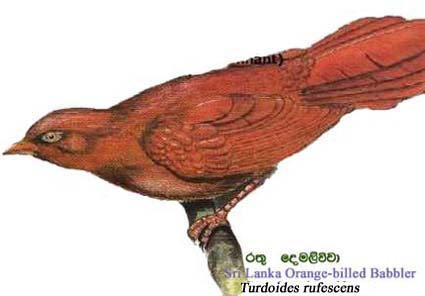
Yala is also a very large reserve with rivers, lagoons, saltpans, rocky outcrops, shoreline and forest in the southeast. Birding in Yala is very interesting because of its complex system of forest. SL Jungle fowl, White-bellied Fish Eagle, Grey-headed Fish Eagle, Painted Stork, Black- necked Stork, Lesser Adjutant, Pompadour Green Pigeon and flocks of flamingoes can be seen in this reserve.
Evening at leisure after a long journey.
Night at Yala Village Hotel or similar.
Day 8 - Yala – Bundala – Yala [FB]
Morning safari at Yala after breakfast.
Lunch at the hotel.
After lunch a visit to Bundala Bird Sanctuary.
The high species richness of birds in the BUNDALA NATIONAL PARK resulted in it being declared as Sri Lanka’s first Ramsar site in 1990. A wetland of international importance for migratory waterfowl. The park consists mainly of dry thorny scrubland and lagoons. The highlight of Bundala is the migratory Greater Flamingo, which visits in large flocks of over 1000 individuals, from Rann of Kutch- India. In particular you may find Indian Cormorant, Yellow Bittern, Black-crowned Night and Purple Herons. The area is also famous for crocodiles.
After the tour back to Yala Village for dinner & the night stay.
Day 10 - Yala - Singharaja [FB]
From Yala, leaving to Singharaja after breakfast.
Lunch at the Singharaja Kudawa Camp.
SINHARAJA rain forest, which is a world heritage site, may be described either as a Tropical Lowland Rainforest or Tropical wet evergreen forest. Birding in this ecosystem is very interesting. 95% of the endemic birds of Sri Lanka have been recorded in Sinharaja.
Sinharaja is the best location to observe the flock behaviour of birds We will be looking for Sri Lanka Spur fowl, Sri Lanka Jungle fowl, Green-billed Coucal, Red-faced Malkoha, Blue Magpie and Spot-winged Thrush, Endemic White-faced Starling, Sri Lanka Myna amongst others. Also keep an eye out for the endemic purple-faced leaf monkeys moving through the canopy, and the impressive grizzled Indian squirrel.
After lunch forest exploration.
Night BBQ dinner & stay over at a fully serviced movable luxury camp.
Day 10 - Singharaja - Colombo - Katunayake Airport
Leaving Singharaja to Katunayaka via Colombo.
- End of Programme -